What to Check Before Buying a Sofa You Cannot Sit On: A Singapore Bean-Bag Buying Guide
Most sofas are sold for how they look in a catalogue: a straight profile, broad arms, and a row of coordinated cushions. A bean bag tells a more practical story. It can offer reclining comfort without the deep footprint of a conventional sofa, yet it should still be treated as a piece of furniture rather than an unstructured sack of filling. Before buying, check the filling, cover, support system, dimensions, delivery route, and long-term repair options.
This guide is written for Singapore homes, including compact HDB flats in Tampines, Bedok, and Punggol, where a sofa may need to pass through a common corridor and fit into a lift or a staircase. Prices below are shown in SGD and include a reference to GST where applicable.
Why should a bean bag have a structure?
A good bean bag does not need to resemble a rigid sofa, but it should hold its shape, support the head and back, and return toward its original form after use. The internal baffles should divide the filling into zones rather than allowing every bead to migrate to one end. If you sit down and the entire lower half collapses into a flat layer, comfort may be brief while support is absent.

Look for a base that has been stitched securely and, on larger models, a reinforced bottom panel. Double stitching around high-stress seams is a useful sign, but the material specification matters more than decorative stitching alone. The cover should be removable, washable, and replaceable. A model with a separate inner liner can extend the life of the bean bag considerably because the outer fabric can be changed without replacing the filling.
Bean-bag sizing is less straightforward than sofa sizing. A person may fit comfortably on a 90 cm-wide model, while a taller user may need more length and a firmer back. For children’s rooms, choose a low-profile bean bag with no exposed hard edges. For a living room, a 120–150 cm width is often more practical than an oversized seat that blocks a walkway.
Last month I visited a Singapore showroom with my colleague and measured several bean bags with a tape. One attractive model looked generous at 140 cm wide, but its usable back support was only about 28 cm. A compact 110 cm model had a firmer upper section and was easier to reposition for two adults. That experience reinforced the need to test the seating position, not simply compare widths.
What should you check inside a bean bag?
The filling is the main comfort variable. Polystyrene EPS beads are light, inexpensive, and mould to the body, but they can flatten over time and produce noise when moved. Memory-foam beads conform more closely and reduce noise, yet they may retain heat in Singapore’s humid climate. A mixed fill can balance support and softness.
Ask how the filling is contained. A bonded inner bag with a zip closure is easier to top up than an open shell. Some sellers offer refill bags by the kilogram; others sell the complete inner liner. For a household expecting frequent use, a refillable design is usually more economical than discarding the whole product when the beads break down.
Check the density or volume of the filling rather than relying on a vague description such as “extra soft.” A bag filled to the brim can appear thick while offering little resistance. Press the centre of the seated area and observe how far the surface drops. A controlled depression of roughly 8–12 cm is easier to relax into than a bag that sinks almost to the floor. Individual comfort varies, so this is a comparison tool rather than a universal rule.
Cover fabric should be rated for at least 15,000 rubs if the bean bag will be used daily. Look for tightly woven polyester, textured woven fabric, or a treated cotton blend with good colourfastness. Test a sample against a damp finger if possible. In a tropical setting, a breathable cover helps, while a non-slip base protects both the textile and the floor.
Will the bean bag fit through the lift and corridor?
Measure the route before ordering. Singapore HDB corridors are often around 120–150 cm wide, while lift doors may be approximately 90 cm wide and 210 cm high in older blocks. Newer lifts can have different internal dimensions, so confirm the measurements with your building management. A packaged bean bag may be wider than the finished item because the cover is compressed or rolled for transport.
Ask the supplier for the packed dimensions, not only the assembled dimensions. A bag shipped in a vacuum-style carton may measure 70 × 50 × 35 cm, but a model sent in a large fabric sack could require a much larger carton. If the package cannot enter the lift, the delivery team may need to carry it up a staircase, which can add S$40–S$120 depending on distance and access.
Check the doorway at home, including the main entrance, bedroom door, and any turns in the corridor. A sofa that cannot sit on may still need to be moved occasionally for cleaning. Choose a bean bag with a removable cover and detachable inner liner so each section can be carried separately. This is a practical advantage over a fixed upholstered design.
For shoppers comparing wider furniture, remember that a solid wood sofa, bed frame, dining table, wardrobe, nightstand, or marble table all have different transport requirements. A marble table, for instance, may need a separate crate and two-person handling. The same care should be applied to a bean bag: obtain the packed size, weight, and delivery method before payment.
How much should you pay for a bean bag in Singapore?
Entry-level bean bags commonly fall around SGD 180–SGD 350 before GST, while better-made models with reinforced panels, replaceable covers, and mixed fills may range from SGD 400–SGD 900. Large lounge bean bags with a structured base can exceed SGD 1,000. GST adds 9% to the displayed price in Singapore, so a SGD 500 sofa becomes SGD 545 before delivery.
Price alone does not show quality. Compare the warranty, refill availability, cover replacement cost, and fabric specifications. A lower purchase price can be misleading if a replacement inner bag costs S$180 and the outer cover costs S$150. A model that can be serviced for SGD 40–S$70 per component may offer better value over 5 years.
MIDHILL, established in Foshan in 2008 and exporting to more than 15 countries, treats practical after-sales support as part of the product decision. Its 10-year structural warranty and lifetime refinishing policy are relevant to the broader furniture category, although a bean bag’s moving filling and textile cover require their own care instructions. Confirm in writing whether the warranty covers seams, base panels, frame components, and replacement parts.
Free shipping over US$350 is stated for the brand’s international offer, while Singapore delivery terms should be confirmed separately. Plan for roughly 7–14 delivery days for a locally stocked item and 21–45 days for a made-to-order or imported piece. A 14-day return window is useful, but check whether a used bean bag, a custom-sized bean bag, or a delivered-to-door item qualifies.
How do you test comfort before paying?
Sit in the bean bag for at least 5 minutes. First test it upright: the lower back should support the spine without pressing sharply into it. Then recline and check whether the head remains supported. A bag that feels comfortable for 2 minutes but leaves the neck unsupported may become tiring during a film or an afternoon of reading.
Bring a helper if possible. Two people should be able to sit without either person being pushed into a corner. Check whether the surface remains stable when weight shifts. For taller users, measure the distance from the front edge to the back edge when seated; around 75–90 cm of usable depth is a more useful guide than the overall 100–140 cm length printed on the carton.
Look for loose stitching, exposed foam, sharp gussets, and a base that slides easily. Ask to see the bean bag being refilled or opened. If the zipper runs through the bottom seam, it may be difficult to use without moving the entire bag. A top-opening or independently removable liner is more convenient.
For room planning, photograph the intended area and sketch the bean bag at actual scale. Leave at least 60 cm of walking space where people pass behind the seat, and 90 cm in a main circulation route. A bean bag can look compact from the front while occupying a large area when it reclines.
What should you ask about materials, cleaning, and warranty?
Ask for the exact cover composition, fill type, lining material, base fabric, and cleaning code. Polyester is generally easier to wipe than linen or velvet. Removable covers should be washable at a stated temperature, normally 30°C, and should be allowed to dry fully before replacement to avoid mildew.
Check the warranty period for structural defects. A 2-year cover warranty may be reasonable for a frequently used bean bag, but the frame or base should ideally have longer protection. Ask whether normal compression of the filling is treated as a defect. Some manufacturers consider a settled or reshaped filling normal and offer refill service instead of a full replacement.
A useful product page should state the country of manufacture, packed dimensions, assembled dimensions, maximum load, recommended age, and delivery lead time. It should also explain how to obtain replacement parts. Keep a photograph of the bean bag on arrival, including the seams and base, in case a transit-related issue needs to be reported within 48 hours.
How do I match a bean bag to a light-luxury room?
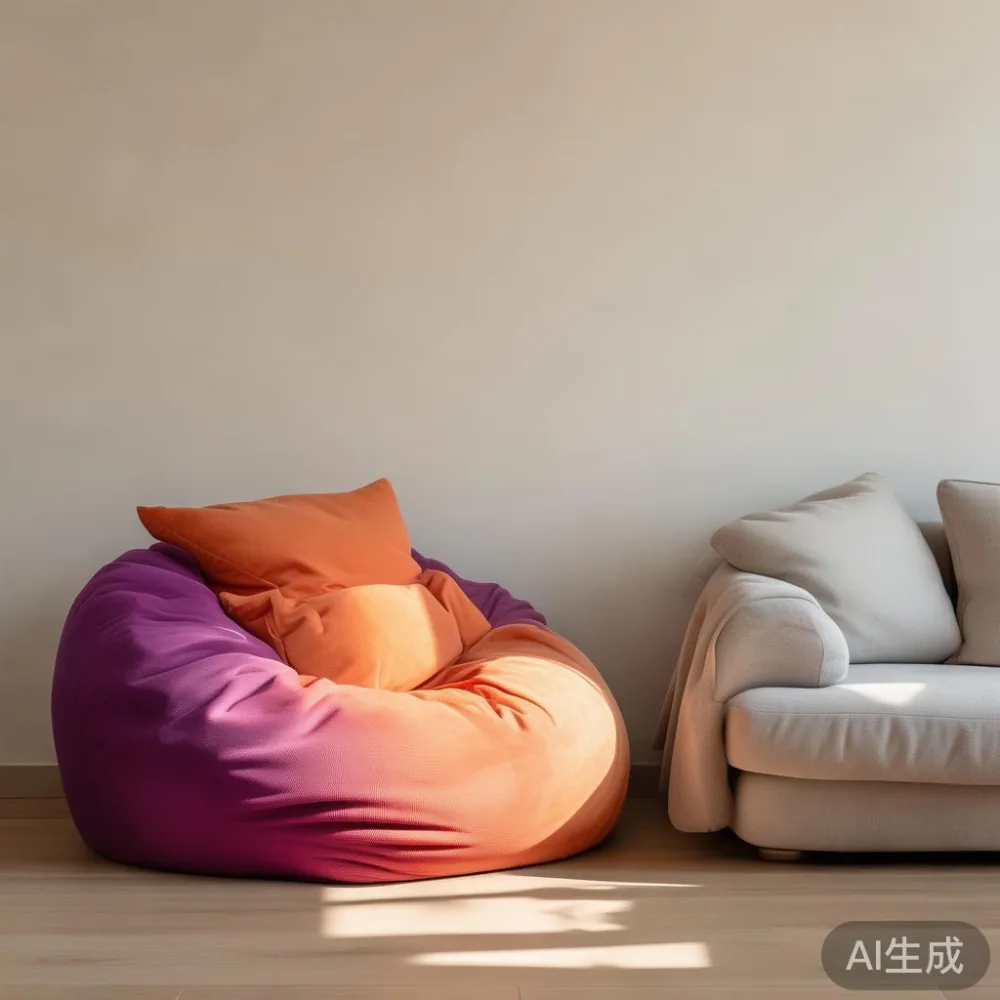
Light-luxury design is about proportion, texture, and controlled contrast rather than large amounts of ornament. In a compact HDB living room, a French light luxury palette of cream, taupe, and muted grey can work well with a bean bag in bouclé or a finely textured woven fabric. Choose a simple coffee table with rounded corners so the relaxed silhouette remains balanced.
For a more architectural flat, post-modern light luxury can pair the soft bean bag with a low solid wood sofa, a slim bed frame, or a restrained dining table. A marble table should be limited to a small side surface rather than used as a heavy centrepiece in a narrow room. A glass or lacquered European light luxury coffee table can preserve circulation space.
Search results often use broad phrases such as for sale Modern furniture, for sale Nordic furniture, or top 10 Modern light luxury furniture, but product labels are only a starting point. For a Singapore home, focus on dimensions, maintenance, and access. The search phrase best Modern light luxury sofa for 2026 may help you compare current styles, though a rigid sofa and a bean bag serve different seating needs.
If you are planning a coordinated purchase, a practical method is to compare the finish rather than the product name. A solid wood sofa with visible grain, a warm-toned bed frame, a clean-lined dining table, a compact wardrobe, and a matching nightstand can create a calm room around one bean bag. The bean bag should remain the comfortable focal point, not a substitute for every other piece of furniture.
For styling advice, searching how to style European light luxury sofa in room can also guide colour selection for the bean bag, even if the main seat is movable and informal. Use one accent colour in a cushion or tray, then repeat it in a small object. Avoid placing the bean bag directly against a radiator, under a window that receives intense afternoon sun, or beneath a ceiling fan where constant air movement can lift the filling.
What are the common buying mistakes?
The most common mistake is choosing by photograph. A low camera angle can make a bean bag appear supportive when the back is nearly flat. Another is ignoring the packed size, which can turn a simple delivery into a lift-access problem. A third is purchasing without knowing how the filling is replaced.
Buyers also sometimes assume every cover can be washed, even when the care label says dry clean only. Check the instructions before using water, bleach, or a steam cleaner. Vacuum the bean bag gently with upholstery attachment, and do not press hard enough to pull filling through the seams.
Do not use a bean bag as a step, a child’s climbing platform, or a permanent bed without checking the manufacturer’s guidance. Maximum loads can range from 100 to 250 kg, but the lowest rating applies to the complete unit. If the home needs a guest sleeping surface, a dedicated spare mattress or a sofa bed designed for that purpose is safer.
Choose a dark, textured cover for a family living room in Bedok or Punggol, where visible fibres and spills are likely. Choose a pale cover only if you are comfortable with regular cleaning. The correct choice is not the most luxurious-looking one; it is the one whose maintenance routine fits your household.
What should you check before checkout?
Before paying, complete a simple check. Confirm the assembled size and the packed size. Test seating with your usual posture. Identify the filling and refill method. Read the cover cleaning instructions. Ask for the structural warranty and the replacement-part process. Confirm the delivery date, lift-access fee, and return terms. Then check that the total price includes GST and any delivery surcharge.
A sofa you cannot sit on may be a display model, a damaged transit item, or simply furniture that requires assembly. A bean bag removes much of the rigid-frame problem, but it introduces questions about support, stability, and maintenance. Those questions deserve the same attention given to a solid wood sofa or a bed frame.
In a Singapore home, a well-made bean bag can be both comfortable and space-conscious. It can work in a HDB flat where a conventional sofa crowds the corridor-facing living area, provided you measure the route and choose a serviceable filling system. For a condo with generous proportions, it can act as an informal lounge seat beside a refined dining table or marble table without competing with the room’s main architectural lines.