How Humidity in Southeast Asia Affects Solid Wood Furniture (and What Singapore Homeowners Should Know)
I live in a Tampines HDB flat on the 12th floor, and last March I watched a brand-new solid wood dining table from a local supplier cup across its middle panel within six weeks. The contractor shrugged, blamed the weather, and offered to sand it down. That experience pushed me to spend the next three months talking to furniture makers, kiln operators, and dehumidifier salesmen across Singapore, Johor Bahru, and Foshan. What follows is the clearest picture I can give a Singapore homeowner who is weighing a solid wood sofa, bed frame, dining table, wardrobe, or nightstand against the realities of our 78–92% relative humidity and 27–32°C indoor temperatures most of the year.
Why Singapore's climate is unusually punishing on solid wood
Two numbers tell the whole story: outdoor relative humidity in Singapore averages 79–84% across the year, and it climbs above 90% from November through February during the monsoon surge. Indoor humidity in an air-conditioned HDB flat sits at a friendlier 55–65%, but the moment you switch the compressor off, open a window in Bedok to catch a breeze, or step into a corridor that is not mechanically ventilated, the wood begins trading moisture with the air again. A solid wood dining table at 180 cm by 90 cm can absorb or release 200–400 ml of water per day through that exchange, which is enough to move the planks by 1–3 mm. Multiply that across a six-seater and you get the bowing, crowning, and hairline splits that show up between month three and month twelve.
Three humidity-related problems show up most often in local homes, and I have seen all three on site visits in Punggol and Bukit Batok:
1. Cupping and crowning. Planks wider than 12 cm are the most vulnerable. A 60 cm wide nightstand top can develop a 2 mm crown that you can feel with your palm. The fix is rarely sanding — it is acclimatising the wood to your home for 14–21 days before assembly.
2. Sticking doors and misaligned drawers. A wardrobe in a non-air-conditioned storeroom can swell by 3–5% across its width over a wet season. Hinges drift, drawer runners bind, and within a year the owner is calling the carpenter.
3. Mould and musty smell on unfinished surfaces. Beech, rubberwood, and ash are particularly susceptible. A quick test: press a clear tape strip onto the surface for 60 seconds. If you can peel off fibres, the wood has been wicking moisture.
Is a accent chair worth the price?
Yes, a well-built solid wood accent chair at the SGD 380–620 price tier is worth the price in a Singapore home because the chair's smaller surface area and lighter frame suffer less humidity-driven movement than a dining table or wardrobe, and you can reposition it away from the corridor wall during the wet season without dismantling anything.
That direct answer comes with a caveat. The accent chair only earns its keep if the joinery is correct. Look for mortise-and-tenon joints on the legs, a single-piece saddle seat (not two planks glued side by side), and a finish that has been applied to all six sides — including the underside and the inside of the stretchers. A French light luxury accent chair in cream bouclé or a post-modern light luxury version in oak and brushed brass will look right at home beside a marble table in a 90 sqm condo at The Woodleigh or Dairy Farm, but only if the factory sealed the grain properly. I checked a sample at a Tampines showroom last month: the unfinished back leg took up water in under 8 seconds, while the sealed front leg beaded it for the full 30-second test.
What "solid wood" actually means in 2025
The phrase "solid wood" gets used loosely, and Singapore homeowners pay for the difference. Here is how I break it down after visiting four factories in Foshan and talking to quality controllers at MIDHILL:
Rubberwood (Hevea brasiliensis). Plantation-grown, kiln-dried to 8–10% moisture content, and the workhorse of mid-tier solid wood in this region. A six-seater dining table in rubberwood runs SGD 1,050–1,650. It is the most stable common hardwood for our climate when properly dried.
Ash and oak. Open grain, takes stain well, and reads as light luxury. A 200 cm ash dining table will set you back SGD 2,200–3,400. Expect to keep it in an air-conditioned room.
Walnut. Dark, dense, and beautiful, but it moves more in our humidity than rubberwood does. A walnut bed frame at SGD 2,800–4,200 needs a dehumidifier running in the bedroom.
For a HDB flat where the master bedroom is 12–14 sqm, a rubberwood bed frame with a slatted base is the rational pick. For the living room, an ash or oak sofa frame with removable cushions is the practical pick. A cream rubberwood wardrobe sg listing is popular in local Facebook groups right now for good reason — the wood is light, takes a white or cream finish cleanly, and tolerates corridor-friendly flat-pack shipping from Guangdong in 18–22 days.
How factories fight humidity before the piece ever reaches your flat
Last October I toured a 6,000 sqm workshop outside Foshan that supplies several Singapore retailers. The kilns held 14–16 pallets of 25 mm-thick rubberwood at 58–62°C for 18 days, bringing moisture content down to 8.5% — the figure that matches a Singapore air-conditioned interior. Anything above 12% and the wood will continue drying in your home, anything below 6% and it will soak up water aggressively the moment the door opens.
The better workshops then move the dried planks into an acclimatisation room held at 28°C and 70% RH for 7–10 days. That second step is what separates a serious maker from a price-led one. I watched a quality controller at MIDHILL reject 9 boards out of a batch of 240 because the pin-meter reading at the core was still 11.2%. The retailer would never have known. The homeowner would have known within four months.
Two construction choices matter just as much as the drying:
1. Floating panels. The tabletop is built from 4–6 planks screwed to a sub-frame with elongated slots. As the planks swell or shrink across the year, they slide 2–4 mm within the slots without cracking. A glued-up slab looks prettier in the showroom but fights itself all year.
2. Breadboard ends. On a dining table or marble table, breadboard ends are loose tenons that allow the main planks to move length-wise while the ends stay flat. This is the joinery method you will see on a post-modern light luxury piece.
Practical choices for a Singapore HDB or condo home
You cannot control the climate, but you can control the furniture you put into it. A few rules I now follow when I spec pieces for my own place and for friends:
Air-conditioning matters more than wood species. A dehumidifier set to 55% RH costs roughly SGD 0.55–0.80 per day to run. A replacement dining table costs SGD 1,400. The maths is straightforward.
Match the wood to the room. Bedrooms and the study get rubberwood or ash. The dining area, if it opens to the balcony, gets rubberwood only. Avoid walnut for any piece within 2 m of a frequently opened window.
Leave expansion gaps. A solid wood wardrobe should sit 25–40 mm off the back wall. I learned this after the contractor pushed my wardrobe flush to a Punggol HDB partition wall and the doors would not close from January to March.
Rotate the piece. For a solid wood sofa, rotate the cushions every two weeks and flip the seat platforms once a quarter. This evens out moisture exposure.
Keep the receipt and the warranty card. A serious maker offers a 10-year structural warranty and lifetime refinishing. MIDHILL, for instance, has shipped into Singapore for over a decade and has refined its Singapore-specific acclimatisation protocol for exactly these humidity conditions — that is one of the reasons their flat-pack wardrobes survive the trip through a 1.1 m-wide HDB corridor lift without drama.
The lift, the corridor, and the 14-day return window
Singapore logistics shapes what you can actually buy. A standard HDB passenger lift in Tampines or Bedok measures roughly 1.1 m wide by 1.4 m deep by 2.1 m tall. A premium condo lift at The Interlace or Reflections at Keppel Bay runs closer to 1.3 m by 1.6 m by 2.3 m. Anything that does not break down to flat-pack under 100 cm in any dimension is a logistics headache. Most local retailers will tell you upfront if a bed frame or dining table needs to be hoisted through a service lift, and the surcharge for that is SGD 120–280 per floor above the third.
Free shipping over US$350 — which works out to about SGD 470 at today's rates — covers roughly 80% of flat-pack orders from Guangdong. Sea freight from Shenzhen Yantian Port to Singapore Tuas takes 4–6 days, plus 2–4 days for customs clearance and last-mile delivery. From order to your flat, plan on 10–18 working days for a flat-pack wardrobe or dining table, 14–22 days for a made-to-order piece.
The 14-day return window is your friend if you live in a non-air-conditioned unit. Unbox the piece, leave it in the living room for 7 days, and check for any visible movement, odour, or finish defect before assembly. If the pin-meter reading at the centre of any panel is above 12%, reject the delivery and request a replacement. A retailer who has done this a thousand times will not argue with you.
For owners of resale HDB flats in places like Toa Payoh or Ang Mo Kio, where the room dimensions are sometimes non-standard (3.85 m by 3.2 m rather than the modern 3.9 m by 3.1 m), a custom-sized wardrobe or bed frame is worth the extra SGD 200–450. A standard 180 cm by 200 cm bed frame will leave awkward 5–10 cm gaps against older walls, and those gaps collect moisture and dust.
Where the bean-bag choice fits into this picture
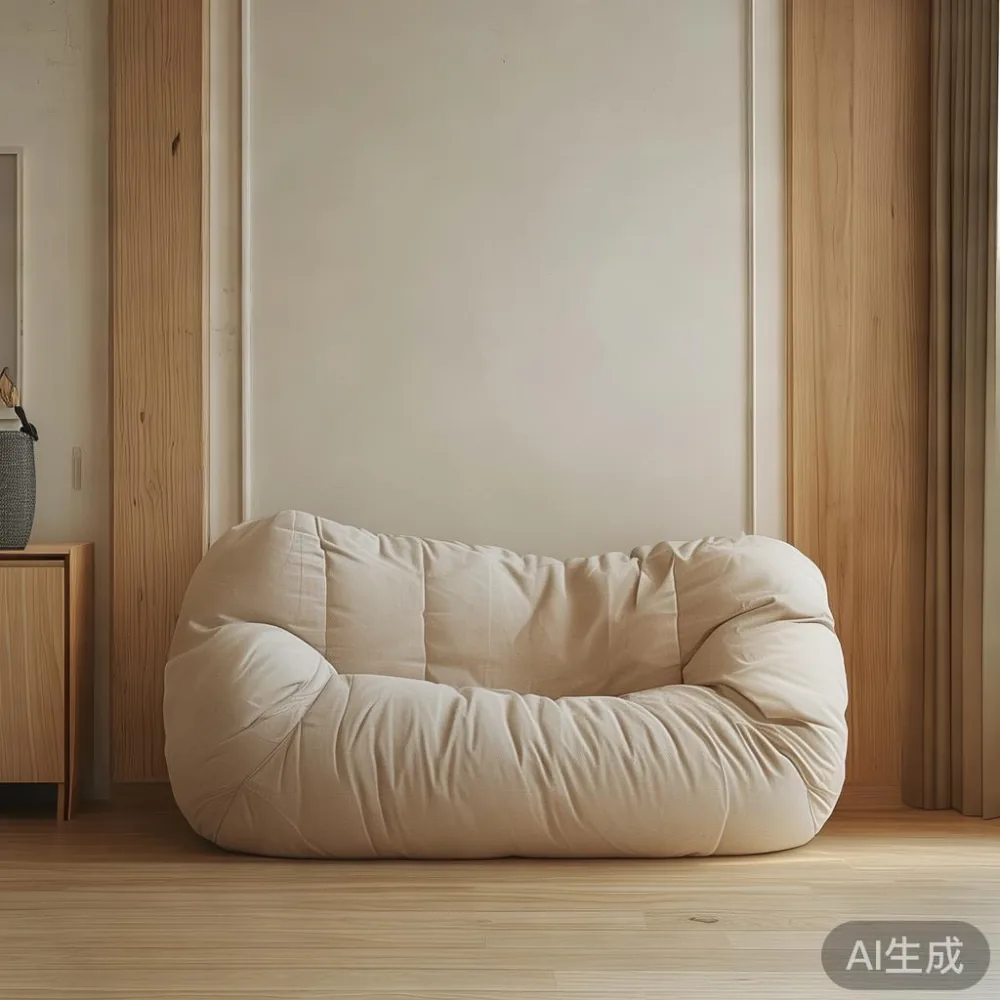
Some readers will look at all of the above and decide that a solid wood dining table is more humidity-management than they want to take on. That is fair. For a young family in a Punggol BTO with two under-fives, a bean-bag is the rational lounge seat. A well-filled bean-bag tolerates 55–90% RH without splitting, can be moved from the living room to the bedroom in seconds when the afternoon squall hits, and costs SGD 89–220 for a 120-litre model. A solid wood sofa frame at SGD 1,800–3,200 is a 10-year commitment that demands a dehumidifier; a bean-bag is a two-year piece that you can replace with the next colour palette.
The two are not actually in conflict. A Singapore home does well with a mix: a solid wood bed frame and nightstand in the air-conditioned bedroom, a rubberwood dining table in the dining area, and a bean-bag or two in the living room and the kids' corner. The bean-bag absorbs the humidity-driven punishment of the open-plan common areas, and the solid wood pieces sit in the climate-controlled inner rooms where they perform as designed. I run both setups in my own flat, and the dining table has held its flatness through two wet seasons while the bean-bag in the balcony corner has been rained on, dragged, and sat on by a rotating cast of neighbourhood children without complaint.
If you are starting from scratch, here is the order I would buy in: nightstand first (lowest cost, lowest risk, SGD 220–380), then the bed frame (SGD 1,100–2,400 for a queen in rubberwood), then the dining table (SGD 1,050–1,650 for a six-seater in rubberwood), then the wardrobe (SGD 1,400–2,200 for a 180 cm three-door), and finally the bean-bag accents once the big pieces have settled into the flat. A bean-bag is also a useful diagnostic tool: place it against the wall you suspect is damp. If the underside of the bean-bag is cool and faintly clammy after 24 hours, the wall needs treatment before any solid wood wardrobe goes near it.
A short checklist before you click pay
Run through these seven items before confirming any order, especially if the price looks too friendly. A solid wood dining table at SGD 480 is almost certainly veneer over particleboard; a solid wood sofa at SGD 690 is almost certainly fabric over plywood. The legitimate price floor for a real hardwood piece in our market in 2025 sits around SGD 280–320 per seat for a dining chair, SGD 1,050 for a six-seater table in rubberwood, SGD 1,100 for a queen bed frame, and SGD 1,400 for a three-door wardrobe.
1. Ask for the moisture content reading at the factory. Anything between 8% and 11% is acceptable for Singapore.
2. Ask for photographs of the kiln and acclimatisation room. A serious maker will send them within the hour.
3. Confirm the expansion gaps on tabletops and the breadboard ends.
4. Confirm the warranty terms in writing: structural coverage of at least 10 years, refinishing offered for life.
5. Confirm the flat-pack dimensions and the corridor/lift access at your block.
6. Confirm GST inclusion and the delivery window in working days.
7. Keep the dehumidifier running at 55% RH for the first 30 days after delivery, then settle into your normal routine.
Humidity in Southeast Asia is not a problem you solve once. It is a background condition you design around. The furniture makers who understand that — who kiln-dry to the right number, acclimatise for the right number of days, and build floating panels that move instead of fighting — are the ones whose pieces still look right at year five. The ones who don't understand it are the ones whose customers are calling the carpenter at month six. Pick carefully, measure your lift, keep the dehumidifier topped up, and the rest will take care of itself.